
Table Of Contents
- The Loss of Physical Media and Its Consequences
- The Big Short Review
- Slumdog Millionaire Review
- Beau is Afraid Review
- The Room Review
- You Don’t Mess Around with Jim Review
The Loss of Physical Media and Its Consequences

The death of physical media has been quick and painless as at a first glance, the consumer has only benefitted from recent changes. With the death of the CD, DVD, and book, a person can now access nearly limitless entertainment online for the relatively small price of a subscription to one of the myriad streaming services. Still, is it possible that the downfall of physical media has had unintended consequences which cheapen the experience of art consumption in the modern world? I believe the answer is clearly in the affirmative.
Physical Media has a multitude of benefits that cannot be found in the electronic consumption methods currently used. Firstly, physical media required commitment to a work of art. Purchasing a record or a DVD meant a much larger investment into a tangible piece of art. This means that the consumer is much more likely to engage with the art frequently and on a deeper level. If I spend 20 dollars buying a movie, you bet I’m going to watch it more than one time. Physical media also encourages intentionality in artistic enjoyment. Because access is more limited, one has to be more careful in choosing what work of art to invest time and money into. There is no longer a bottomless well of options available to the consumer through the internet so a more serious decision is required long before the listening, watching, or reading starts. This holds true on the producer’s side of things as well with companies having to invest more money into each artist and therefore being more careful about who they give the greenlight to. Finally, physical media provides a natural container for artistic expression which forces artist to be more nuanced and complicated in their work. An album, book, or movie, in a sense provides a canvas for the artist to work on which is a far cry from the world of today where short form content, 3-minute pop songs, and tabloids have all but replaced art.
Limitations and downsides of the new electronic medium must also be mentioned. With the rise of short form social media content, it seems that artistic endeavors have been trimmed downed and designed to appeal to the basest animal instinct. Songs have to be catchy and loud and above all, short. Movie need to have short clips that can be shared over social media to generate hype for the project. It seems that the new electronic medium for art has made things much more superficial and shallower. To illustrate the problem further ask yourself: would anyone ever buy the record of a song they heard on TikTok?
However not all is bad with the streaming consumption model. It is true that democratization and accessibility of art have increased. It is possible for anyone, anywhere to find almost any piece of music ever recorded with a simple Spotify subscription. Furthermore, anyone, anywhere can share their own music on Spotify enabling smaller artists and creators. These positives cannot be overlooked when critiquing the modern art landscape. What then is the solution? Should we seek to return entirely to physical media? I think the answer lies in accepting that the streaming model of artistic consumption is here to stay and coming up with new, innovative ways to preserve the depth and nuance of art within the constraints of the online world.
The Big Short Review

The Big Short is directed by Adam McKay, stars Christian Bale, Ryan Gosling, Brad Pitt, and Steve Carrell, and tells the story of the causes of the 2008 financial crisis and those few investors who saw it coming and made a huge profit.
To start, the things the movie did right. The cast is somewhat surprisingly full of A-list talent and the movie benefits from some excellent performances from Christian Bale, Ryan Gosling, and Brad Pitt even though their screen time is limited by the vast number of storylines. Christian Bale especially stood out to me in his portrayal of the eccentric and odd Dr. Michael Burry making the character intriguing and fun to watch. Additionally, the film has an uncanny ability to make something as complicated as Collateral Debt Obligations and Credit Default Swaps entertaining. In several instances, The Big Short seems to recognize the subject matter is too complicated to even try and communicate through dialogue so they just have a famous celebrity come out and explain the concept outright. This is very effective and keeps the audience from getting bored of seeing investors talking in generic office buildings. Given the serious subject matter, it is a little surprising to see the movie have so much humor. While the tragedy of the situation is definitely there, it is counteracted by the many humorous and exaggerated moments.
Even though the film does as good a job as could be expected explaining a complicated issue, in the end, it is limited by its own topic which detracts from the characters. Obviously, the movie is not meant to be focused on the characters but with the amount of depth that Christian Bale was able to convey in the limited amount of screentime he had, it would have been interesting to see a film that focused more on some of the individuals and the effect of profiting so heavily from an event where most people suffered. Steve Carrell’s performance was unconvincing to me as he always seemed like he was trying to hard to be serious. This made all of his lines seem oddly comedic and definitely exaggerated. Another thing that made the movie worse for me in particular was the fact that outside of the explanation of the 2008 financial crisis, the film does not have a whole lot to offer. Since I had already read the book The Big Short, I already knew the intricacies of the mortgage meltdown and so many parts of the movie were kind of boring, which I expect it will be for most people who have previous knowledge of the 2008 financial crisis. This is more a nitpick with the limitations of films that are based of technical events as The Big Short does a phenomenal job with the material it has to work with.
In conclusion, The Big Short is a surprisingly funny, technically dense, entertaining movie which is worth watching for anyone who is looking to learn more about the financial crisis that has shaped much of the world economy in the past decade and who wants to have a good time doing it.
Slumdog Millionaire Review
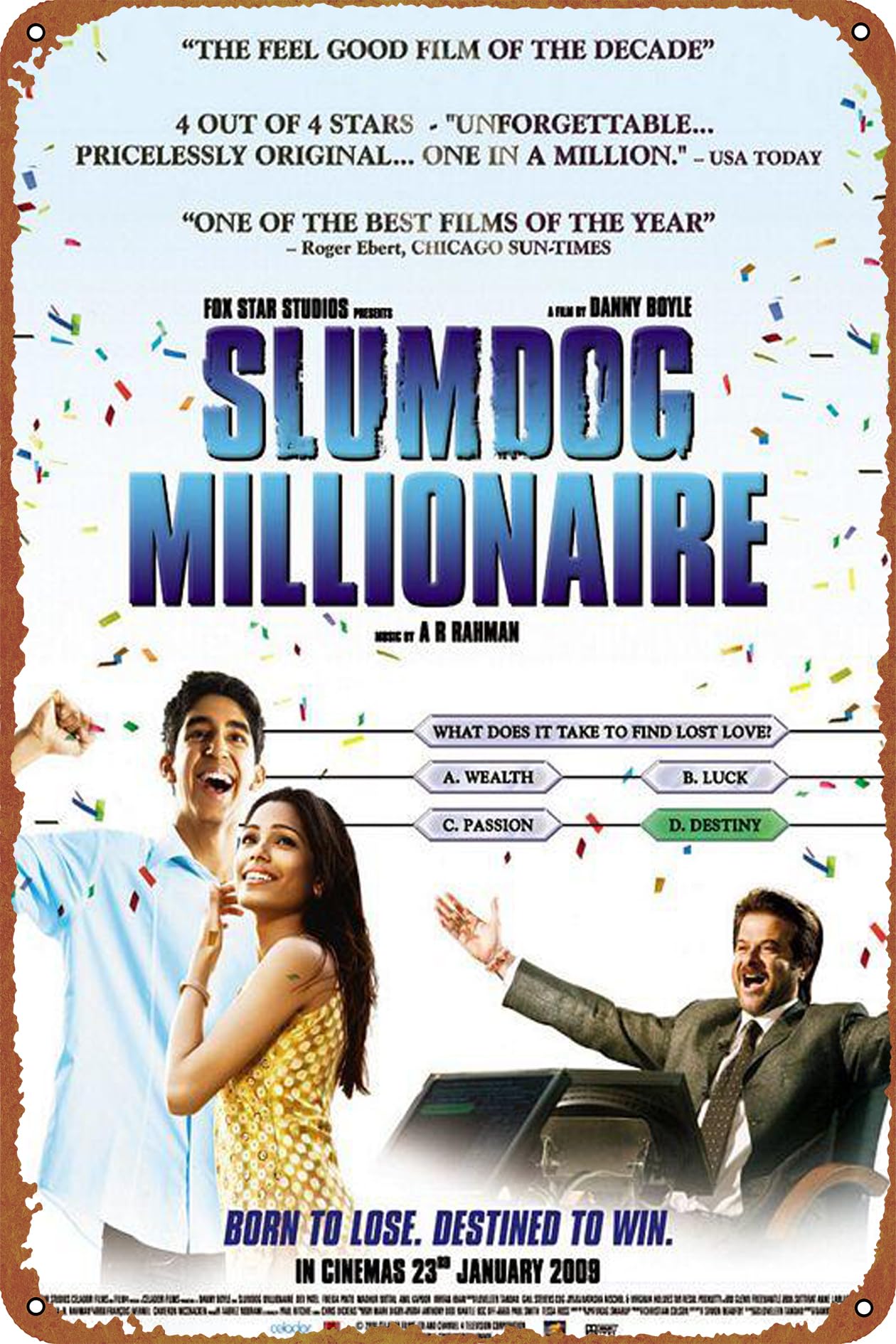
Slumdog Millionaire was directed by Danny Boyle, stars Dev Patel, Freida Pinto, and Madhur Mittal, and tells the story of a young Indian man’s rise from poverty to winning the tv show Who Wants to Be a Millionaire. While the film is technically brilliant with the music, cinematography, and editing all being top-tier, the contrived and campy plot with largely one-note characters holds the film back from being truly deserving of all-time status.
The story of the main character, Jamal Malek is shown through a series of flashbacks while Jamal’s participation in the game show acts as a framing device. This is a neat gimmick but, to me, it ultimately felt contrived and cheesy, taking away from the grittier aspects of Jamal’s real-life hardships. The film also suffers from characters with little nuance. Most of the people in the film are either entirely good or bad with conflicts between characters that do arise being resolved in cheap and easy ways without being fully explored. Jamal himself is very boring as he has no personality being only driven by his desire to rescue his childhood girlfriend. However, the movie is mostly able to mitigate this problem by keeping up a consistent pace so that we are always engaged in the latest exploits of Jamal and his brother even if we do not grow invested in their characters.
While its plot and characters leave much to be desired, on a technical level, Slumdog Millionaire is a near perfect film. The visuals in the film are done very well with the movie unafraid to create a dark and gritty atmosphere appropriate to the poverty and destitution surrounding the main characters. This was a refreshing break from the films of today which always feel so polished and clean. The color palette of the movie was also commendable and added to the surrealistic quality of the film which is fitting given it is a retelling of Jamal’s memories. The cinematography also stood out for being interesting and dynamic. Nearly every scene had a shot with a gorgeous visual or an interesting camera angle or technique. This greatly contributes to the fast-paced action scenes in the movie while also making it feel rougher and more realistic and less like a movie created on a soundstage.
A review would be remiss if it did not at least mention the criticism from many Indian film reviewers over the film’s negative portrayal of India as a nation of poverty, slums, and gangs. While it is true that the film does not make India look good as a country, it is only displaying one aspect of the region. As a counterargument, there are countless films that make America look terrible that get released and have had success. Rather than criticizing the film on this account, it would be better to invest time in telling visual stories of India that show a different aspect of the nation, one that shows the strengths and potential of the Indian people.
To conclude, one question comes to mind: How on earth did Slumdog Millionaire manage to win eight Academy Awards including Best Picture and Best Adapted Screenplay? Clearly, the film has it strengths but eight Academy Awards puts it in the realm of films like On the Waterfront and Lawrence of Arabia, a place where I think it certainly does not belong. In my opinion, Slumdog Millionaire is the kind of movie you can sit down and watch any night of the week without getting too invested. It is the kind of film that presents no strong emotional themes and, being so inoffensive, will be universally entertaining for everyone.
Beau is Afraid Review

Ari Aster’s latest film is a weird, surreal, disturbing three-hour long journey that leaves the viewer wondering there was something more to the story than obvious one-note premise. Beau is Afraid tells the story of the Beau Wasserman, a nervous and indecisive man, as he travels through a wacky and oftentimes frightening world to visit his mother. The film is almost episodic in nature, however, to its detriment, the many parts fail to develop or build off of one another. Because of this, the main theme of the film, namely trauma and the effect of child abuse, feels extremely underdeveloped given the films long runtime.
To begin with, the good. One can critique many things about Ari Aster’s films but his skill with camera placement is undeniable. The cinematography of the film is excellent throughout. In particular, the use of the language of film to make Beau’s feel surreal and out of the ordinary. The cinematography works hand in glove with the set design and colors to create visually memorable and interesting shots. A standout was Beau’s apartment building which has a bizarre grimy quality and is equally terrifying given the vast array of wild characters that inhabit the place. The film also has a unique animated section in the middle, which will probably be what a lot of people remember from the movie and felt almost like a standalone short film on its own. While Beau is Afraid is technically sound, the plot and characters are not interesting enough to come close to justifying the insane three-hour runtime.
Most of the problems with Beau is Afraid come from the fact that it is probably double the length that it should be. The main idea of the film could easily be conveyed in under an hour and so the three hours of film end up just saying the same thing over and over again. Additionally, what little mystery and intrigue the film has, it does not value. There is not really a big reveal which shifts our perspective but rather, the finale only reinforces what we kind of already knew. It seems Aster does not know the limitations of surrealism in a film. The surrealist elements must be continually dynamic in order to keep the viewers attention, and even then, its value lies in its irregularity. When the viewer is steadfastly fed bizarre scenarios and images with no rhyme or reason, it becomes the new normal and any sense of weirdness is lost. In other words, we are drawn towards the surreal because of its contrast to what is normal. In Beau is Afraid the entire film makes no realistic sense which means that outside of its relatively basic theme, there is nothing to the plot. I was curious of when Aster would tie Beau’s extraordinary adventures to the real world but this never occurs and Beau (and the viewer) are merely left accepting that all the crazy and insane stuff that happened as the film’s reality. Aster essentially took three hours to say a message which could have been conveyed in a much, much shorter length of time. The lack of strong characters also makes this a problem because Beau is entirely uninteresting. He lacks initiative and all the events of the story basically happen to him as an unwilling participant.
Interestingly, Beau is Afraid might function better as a tv series with each part of the movie being a different episode. This would give the viewer a bit of a break from all the craziness between episodes. Another way to improve the film would be to expand on the themes in a deeper level or tie them back to reality so the viewer can have something more to take away. All in all, Beau is Afraid is not a film I would recommend anyone watch unless they absolutely adore weird surreal imagery with little concern for characters, plot, or any semblance of reality.
The Room Review
The Room is a folkloric album by Fabiano de Nascimento and Sam Gendel. It is a mix of various folk songs from parts of South America and features a 7-string guitar and a soprano saxophone (played by Nascimento and Gendel respectively). Inexperienced music listeners (myself included) might mistake the saxophone for some type of flute as it is very high and plays many precise quick flute-like sequences. The Room is entirely instrumental which serves to showcase the immense talent of the two musicians on their instruments. The guitar work of Fabiano de Nascimento in particular blew me away in regards to the speed and dexterity of the notes. Even though it is just two instruments the range of sounds that is created is truly impressive. I will admit that there were times throughout the 35-minute runtime that the soprano saxophone started to feel tedious as it constantly went up and down the playing the melody, but for the most part, the album is able to maintain a fresh feeling despite the lack of instrumental variation. Needless to say, for those who bear a dislike of instrumental music, this album is probably not going to convince you otherwise. From the limited research I have done on Nascimento and Gendel, they both come from jazz backgrounds so it makes sense that there are parts of the album that sound somewhat jazzy. However, the folkloric sound is still the dominant force on the project. I enjoyed this album much more than I expected to because, even though the melodies are not as varied or dynamic as I would like, the skill that can be palpably heard on the record and the imperfections from the real life playing of the instruments keep the songs engaging.
The Room begins with “Foi Boto” a slow and melodious piece with a catchy melody played by the soprano saxophone which sucks the listener in. Next comes “Capricho”, a much faster song, this time with a jazzy feel to the saxophone and a moving rhythm. This is followed by “Astral Flowers”, which has a flowing quality similar to that of moving water. The melody reminds me of Celtic bagpipes and there are some seriously cool percussive elements to the guitar picking on the song. The next track is “Kewere”, a song which starts out slow and contemplative but gradually picks up pace. It tends to go on a little longer than is necessary as the melody gets worn out. “Cores” has a more traditional pop chord structure with a catchy melody to boot. The next song “Txera”, is my personal least favorite on the album with the melody being too repetitive and slow. “Até de Manha” is another slow song while “Poeira” is reminiscent of Astral Flowers with a smooth guitar harmony and a fluid harmony. “Tupi” seems to be a remix of sorts of “Txera” but the last song “Daiana” is an almost classical sounding piece with a very melody. The guitar solo at the beginning is probably my favorite moment on the whole album.
You Don’t Mess Around with Jim Review

You Don’t Mess Around With Jim is the 3rd studio-album from singer and songwriter Jim Croce. The album has 12 tracks and a runtime of approximately 33 minutes. The album is of the folk-rock genre and has an old-timey optimism to it. Additionally, the guitar accompaniment is superb thanks to the contributions of collaborator Maury Muehleison. Croce’s voice itself cannot be overlooked. The simple but strong vocals prove to be endearing and perfectly match with the ballads and acoustic folk sound on the album. Even though the album has its fair share of somewhat droning ballads, the songwriting of Jim Croce stands out on many of the choruses which, though they are simple, tend to stick in the listeners head in a good way.
You Don’t Mess Around with Jim starts with the titular track of the same name. The piece has a simple, steady beat which complements Jim’s vocals as he sings of the fearsome “Big Jim” and his eventual downfall. Similar to the rest of the album, the song has simple yet effective production with a simple melody befitting the ballad. Next is “Tomorrow’s Gonna Be a Brighter Day” is a quieter song but uses the backing guitar and chord changes to make it a pleasant tune to bop your head too. “New York is Not My Home” drops drums entirely opting for a production guitars and strings which adds to the melancholy bittersweet atmosphere of the tune. It showcases Croce’s songwriting skills with a message that resonates with a feeling everyone has felt at one point or another. The album continues with “Hard Time Losin’ Man” which picks up the pace again. The lyrics of this song feature some comedic tales though the melody is quite forgettable. “Photographs and Memories” is a somber and contemplative track which has a surprising amount of melodic and tempo variety given its short runtime. The strings return to the production which gives this piece an appropriate dreamy quality. Next comes “Walkin’ Back to Georgia”, a folksy track from the album. The song is another ballad and exudes the charm that only simple campfire songs can with its gentle guitar strumming. The next track “Operator”, is fantastic start to finish. It sounds much more like a pop song than the other ballads on the album with its catchy guitar motif and up-tempo drums. The melody and the lyrics work perfectly together to tell a story while also being very catchy. Croce’s voice could only be called dependable as it does not stand out as being technically impressive but has a stable and authentic timbre. The next song on the album is “Time in a Bottle”, one of Croce’s most popular songs out of his entire discography. The duality of the fearful realization of the temporality of time and the love of the company of another make the song instantly interesting. The melodies on the chorus and the verse and Croce’s vocals really bring the song to life. “Rapid Roy (The Stock Car Boy)” is yet another ballad about an interesting character. Although the melody leaves something to be desired, the rapid pace is infectious and makes the listener want to move their feet to the rhythm. Next is “Box #10”, a song which tells a story but has a strong enough melody to match the long verses. The guitar accompaniment is truly beautiful and speaks to the talent of older musicians who came before the age of digital music production when prowess on an instrument was greatly appreciated. “A Long Time Ago” is a retrospective on loneliness and eventual contentment found in the company of another. The song is a sweet tune even if it doesn’t merit being played over and over again. The album concludes with “Hey Tomorrow”. The track perfectly ends the project with the hope of an optimistic future. The message, that all we can do is keep on trying to do the best we can, is eternal universal.