
Table Of Contents
- The Unbearable Weight of Massive Talent
- Oppenheimer Review
- The Man Who Was Thursday Review
- Songs in the Key of Life Review
- Innovation, Success, and Disney
The Unbearable Weight of Massive Talent

The Unbearable Weight of Massive Talent is an action-comedy movie directed by Tom Gormican, written by Tom Gormican and Kevin Etten, and starring Nicolas Cage and Pedro Pascal. The film follows Nicolas Cage as a fictionalized version of himself. Down on his luck and in need of money, the actor decides to accept an offer of a million dollars to attend the birthday party of a wealthy Spaniard (Pedro Pascal). However, things take a dramatic turn when Cage is recruited by the CIA to rescue to a kidnapped girl from his benefactor.
This film caught my attention solely due to the title, The Unbearable Weight of Massive Talent, which is cocky as heck, so I went into it with no expectations whatsoever. On the whole, the movie did not disappoint and while I greatly preferred the first 2/3rds of the movie, I was thoroughly entertained for the entire runtime. Both Nicolas Cage and Pedro Pascal are excellent in the movie and their comedic chemistry is a joy to watch. The relationship between their two characters is one of if not the strongest aspect of the movie. As far as the plot goes, this movie is extremely self-aware with many meta jokes around the wacky scenarios that arise. While this makes the movie “funnier” I feel like it detracts from the “character-driven” part of the movie (more on this later). Like previously mentioned, the last third of the movie drags on for a bit too long with added action that seems unnecessary and corny. Additionally, the central conflict of the movie, that between Nicolas Cage and his family, never really gets resolved. The film essentially is so dialed in on being funny and meta that it forgets the story that it started out telling. It almost feels like two movies, one a family drama and the other a spy-action movie, where smashed together somewhat unsuccessfully. The funny part is that the film itself basically says as much but acknowledging one’s weaknesses while doing nothing to address them obviously does not make the film better. Instead, it leaves the audience asking the question, if the writers knew that they were making the story worse, why did they continue to do so? Regardless of this flaw, The Unbearable Weight of Massive Talent still stands on its own as a one-watch comedy movie with some great performances but unfortunately fails to transcend the boundaries of its genre and hold a deeper message.
***SPOILERS BELOW***
The film begins with Nicolas Cage struggling to get the major roles he used to land in the past. Additionally, he is in need of money and has a very rocky relationship with his ex-wife and daughter. Initially, the character is portrayed as a narcissistic jerk, viewing others only for their part in his “movie-star” persona. Based on this setup, one would expect the script would have Cage encounter various scenarios which would allow him to gain new insight into his maltreatment of his family after which, he would have a change of heart. However, this never actually happens and the audience is left with the setup of a conflict followed immediately by an unearned resolution where the entire family gets along well. Once Nicolas Cage arrives in Spain to visit the billionaire Javi, (Pedro Pascal), Cage’s family is essentially forgotten as the film leans fully into comedic territory. The middle portion of the movie is largely taken up by the actor surveilling Javi and trying to find out if he actually kidnapped the missing girl. Added onto this is the fact that Javi is an aspiring screenwriter, so he and Nicolas agree to write a script for a new movie that Nicolas can act in. In a twist that could be seen from a mile away, this movie will end up being Nicolas Cage’s adventure in the CIA with Javi, which is revealed at the end of the film. Nicolas Cage’s family finally becomes relevant as the third act starts when Javi thinks it will be good for him if he clears up his family drama so he flies the ex-wife and daughter out to Spain. Once again, we see that Cage is still selfish and egotistical when attempts at reconciliation fall flat and his daughter testifies on his need to be the “center of attention”. Clearly, the actor still has a lot to do before his character arc can be complete. Unfortunately, instead of a third act climax that tests Nicolas Cage or forces him to change his character to better his family, we are treated to a cheesy rescue mission that includes an unserious firefight and chase sequence where Cage has to rescue his family and another girl from the evil crime lord cousin of Javi. While the ludicrousness of this scenario happening to a famous actor and their family is quite funny, the joke quickly becomes stale as the third act goes on. Furthermore, immediately after the rescue, we cut to the premiere of Javi and Nicolas’ movie where everyone is all smiles. The final scene is one in which Nicolas Cage has a positive interaction with his family and it is assumed that everyone lives happily ever after. Obviously, this is an unsatisfactory ending because Nicolas Cage shows no serious character growth and unless he changed offscreen (between the end of the rescue mission and the premiere of his film) he should still be the narcissistic father he was at the beginning of the film. Additionally, I find it ironic that Cage is maligned for needing to be the “movie star” center of attention yet the film terminates with him being lauded at the premiere of his own movie. In my opinion a much better direction the film could have taken would be to have Nicolas Cage follow a character arc like that of Rick Dalton from Once Upon a Time in Hollywood. This would have the actor accept that he doesn’t need to be the big-time movie star anymore and that oftentimes, this role estranges his family. Perhaps instead of Cage starring in the movie based off of his adventures, we see him hand the role off to some other younger actor while he is content to watch from the background with his family. This arc is also perfectly setup for in the beginning of the movie when Cage’s ex-wife explicitly says that their daughter does not need a “celebrity” she needs a father. The message of the movie could have been about choosing family over fame/career, but instead it chose to be an above average comedic-action movie.
Oppenheimer Review
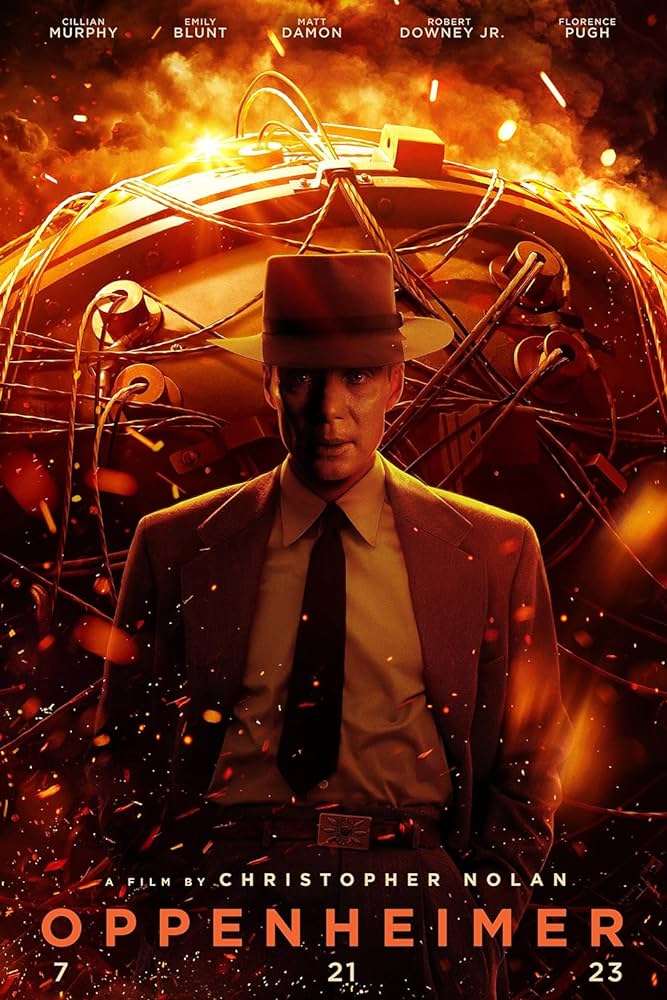
Oppenheimer, directed and written by Christopher Nolan, stars Cillian Murphy as the titular J. Robert Oppenheimer and tells the story of the scientist’s rise from brilliant physics student to leader of the Manhattan Project and his eventual fall from power in the government bureaucracy. Other notable actors and actresses in the cast include Robert Downey Jr., Matt Damon, Emily Blunt, Florence Pugh, Rami Malek, Kenneth Branaugh, and Jack Quaid. The film clocks in at around 3 hours but there is more than enough material about Oppenheimer to warrant that kind of length.
Nearly every aspect of Oppenheimer is meticulously crafted to perfection. This includes everything from the performances of the actors and actresses, the music, the costumes and sets, and the sparingly used special effects. The actors and actresses are all doing their very best with what the script gives them (which is in some cases very little). Cillian Murphy as Oppenheimer is an inspired casting choice and he does an excellent job conveying the character as a somewhat eccentric and introspective genius haunted by his own creation. Robert Downey Jr. also gives a good performance playing the smooth calculating bureaucrat Levi Strauss. In my opinion, Emily Blunt’s acting was nothing special but I would pin this on the script giving her very little to work with in terms of fleshing out her character. The films score composed by Ludwig Goransson is beautifully and perfectly encapsulates the marvel and wonder that should be associated with such a monumental feat of science and technology. The duality of the bright strings combined with the harsh horns seems to represent the duality of amazement and fear that proceeds from the realization of nuclear weapons. As to the visual effects, they are subdued but appropriate. There are people who will probably complain that the movie is too full of talking with comparatively few “mind-blowing” scenes. Additionally, the visual effects that are in the film, are mostly abstract and obscured. I found these choices to be refreshing, and the minimalism present in much of the special effect showed how you can do more with less. Simple things such as sparks and moving lights can be extremely effective when filmed and used correctly.
As far as the technical elements of filmmaking go, there is almost nothing to critique in Oppenheimer. However, the film is far from perfect with most of the problems coming from how the screenplay is written and the creative decisions over the story’s structure. The dialogue in Oppenheimer is not good for several reasons. Firstly, there is too much of it. There is a lot of dialogue in this movie, much of it unnecessary in the grand scheme of things. In many instances, characters seemingly interact more for historical accuracies sake than for the actual narrative. Additionally, the use of dialogue is sometimes a crutch as the movie then does not follow the cardinal rule, “show don’t tell”. This is not as big as an issue for myself as I am used to books and processing information in a “boring” way, but for others, the large swaths of the film that consist of Oppenheimer talking to various side characters in classrooms might seem a bit tedious. Secondly, the dialogue is very unnatural and written as if to accomplish a goal and nothing else. In other words, it seems to me that when Nolan writes dialogue, he starts out with a piece of information he needs to get across, and then has his characters say as much in a succinct and clear way. However, he neglects to keep in mind that these are characters and that they don’t always act in a succinct and clear way in conversation. There are many moments in the movie where a character will make a statement only to be immediately responded to with a coherent well worded question that doesn’t really fit into the natural flow of conversation. This is perfect for scientific discussion but it means that the characters are given less development because not much is revealed through their dialogue. Another problem with the film is the bizarre choice to give Levi Strauss a huge part in the movie. In a movie entirely focused on Oppenheimer, it feels strange to give so much screen time to what is essentially a side character who only had marginal interaction with Oppenheimer. While Robert Downey Jr. did a lot to make Strauss engaging, the audience is still left wondering why we should even care about the petty ambitions of Strauss especially considering that Oppenheimer did not actively have anything to do with his failure to be confirmed. I understand the contrast Nolan was trying to show between a scientist and an ordinary man and how conflict can arise between them but Oppenheimer seemed too passive to justify delving deeper into this theme.
To conclude, Oppenheimer is a technically brilliant historical film. It does its job telling the incredible factual story of J. Robert Oppenheimer and the incredible accomplishment of the atomic bomb.
The Man Who Was Thursday Review
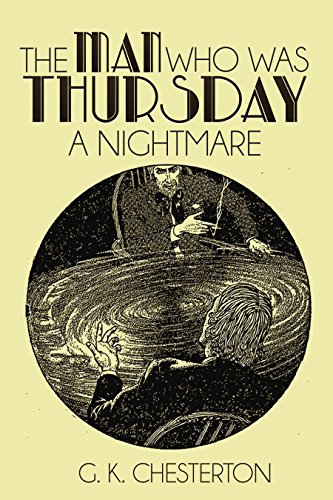
The Man Who Was Thursday is a thriller-adventure novel by a G.K. Chesterton. The book tells the story of one Gabriel Syme who is an investigator for the police tasked with discovering and infiltrating a secret anarchist society. The book is a quick read at around 150 pages and is fast-paced throughout making it easy to enjoy. One special element of the book is its uncanniness and surrealism. Throughout the novel, a series of events occur that are not entirely unbelievable but seem to get increasingly out hand. This forces the reader with no choice but to accept the truth as it is revealed to them with a curious kind of wonder about the unknown. Chesterton, as per usual, is very clever in how he sets up the story and how it all plays out. The unique characters and the unexpected situations they find themselves in provide foundation for many comedic moments. While the majority of the novel is purely a surreal adventure, the ending lays out an allegory that is somewhat controversial. I myself believe that, while the message is wholesome and applicable to everyone, it seems almost ham-fisted into the end of the story to make it deeper than it really needs to be. Another remarkable aspect of the book is its signature style. Chesterton somehow makes every situation, even one involving callous, bomb-throwing, anarchists to be fantastical and light. The book does not take itself to serious and even when the protagonist and his companions facing near certain death, the humor of the situation is evident. To conclude, I will share one quote from the novel changed the way I view the world and contains much wisdom. “Moderate strength is shown in violence, supreme strength is shown in levity.”
Songs in the Key of Life Review

Songs in the Key of Life is the 18th studio album of singer-songwriter Stevie Wonder. It is a double album with 17 tracks and a runtime of approximately 90 minutes. The album features a blend of r&b, soul, and pop and uses techniques and production that was avant-garde at the time and are still influencing music to this day. Since its release, Songs in the Key of Life has inspired many of the greatest pop and r&b artists including Elton John and Kanye West. It is considered among one of the best albums of all time.
Songs in the Key of Life is spectacular from start to finish. The tracks are superb from both a production and a songwriting standpoint. The album can also be praised for its variety as each of the songs have their unique sound. Stevie Wonder’s voice might not stand out on first impressions, but it has a pleasant quality that makes it mix perfectly with the production on the tracks. Additionally, Wonder’s strength as a songwriter can be felt throughout the project as there are a bunch of memorable hooks and verses. While some of the songs are a bit indulgent in their length, the production quality is so high that they can be justified in most cases. The album runs long for modern standards but this is only a problem for projects if filler songs are included to get to the desired length. This is certainly not the case for Songs in the Key of Life where almost every song is a classic.
The album begins with “Love’s In Need Of Love Today”, a soulful feel-good song which oozes positive laid-back energy. The chorus is memorable and pleasant and even though the song is over seven minutes long, it feels much shorter and doesn’t drag on. Next is “Have A Talk With God”, an upbeat track with a positive message. The funky groove and beat alone are a treat on this song but once again, Wonder delivers a catchy hook and chorus. The project continues with “Village Ghetto Land”. This song differentiates itself with the use of regimented strings under Wonder’s poignant lyrics about the plight of minorities in the ghetto calling attention to potent problems which still exist today. Though slow, the melody is still infectious to listen to. An instrumental track titled “Contusion” follows “Village Ghetto Land” and showcases a colorful rhythm alongside a bouncy melody which is supported by backing vocals. While the electric guitar which plays the lead is impressive, it cannot compete with Stevie Wonder’s own smooth voice making this song one of the weaker entries. The next song on the album is “Sir Duke”, a catchy pop song with an impeccable groove. The jazzy chords of this song combined with the captivating melody and verse make this song hold up after infinite replays. Next comes “I Wish”, yet another extremely catchy tune featuring a funk vibe. The brass instruments add a punch to the song while the constant base makes it hard to stop from bumping along. At this point in the album, it must be repeated that the quality of the songs is astounding. They each feel fully realized and complete, being neither too simple nor too complex. “Knocks Me Off My Feet” is a romantic song in which Wonder’s silky smooth vocals standout. As if it needs repeating, the songwriting is top-tier. Wonder’s ability to make complex yet accessible melodies is worthy of commending. It enables the songs to as catchy as standard pop songs while containing enough substance to keep returning to. The album continues with “Pastime Paradise” which most people will instantly recognize as the sample for Coolio’s “Gangsta’s Paradise”. Wonder’s song is just as catchy and is the originator of the iconic string pattern. The song message, a caution against laziness and complacency, is just as relevant today as it was upon release. “Summer Soft” is a jazzier cut on the album but still possesses all of the charm of the previous entries. The songwriting continues to be excellent with the blending of catchy pop melodies and complex chord progressions. The next track “Ordinary Pain”, is a weaker song on the album. The melody is not as strong as the rest of the tunes on the album and it overstays its welcome clocking in at over six minutes. “Isn’t She Lovely” comes next and is a wholesome ode to Wonder’s joy in his daughter and the miracle of life. Aside from the touching lyrics the song has an instantly recognizable chorus and groove with a notable electronic harmonica feature. Even though the track is seven minutes long, it never gets old. Continuing on, “Joy Inside My Tears” is a slow and meandering piece. It lacks a very strong chorus and the ending drags on for a while but this is only because the rest of the album is so incredible. “Black Man” is one of the longest songs on the album with an optimistic theme of interracial harmony. Even though the chorus is repetitive and bland compared to his previous songs, the message and driving rhythm help compensate for this. “Ngiculela-Es Una Historia-I Am Singing” features Stevie Wonder singing in three languages (English, Spanish, and Zulu), a further testament to his seemingly infinite talent. The song has evoked a relaxing and peaceful ambiance with a message about unity in love. The album continues with “If It’s Magic”, a contemplative and slow piece that reflects on the nature of love. The harps and lack of drums change the pace of the album and the ethereal tune easily sticks in the listener’s head. “As” comes next and has an interesting chorus switch from major to minor. That being said, the song does not particularly stand out from amongst the hits on the album. The album concludes with “Another Star” a fast-paced song with a danceable beat. It closes out the project on a high note even if the chorus is not as strong as the tracks at the start of the album.
In conclusion, Songs in the Key of Life is a truly incredible album that radiates optimism and love. The grooves on the project are incredible and the combination of pop appeal and innovative production make it one of the most influential albums of all time. A quintessential listen for any fans of jazz, r&b, soul, funk, and pop Songs in the Key of Life is truly a 10/10.
Innovation, Success, and Disney

Attaining commercial success in a creative industry is a very difficult endeavor. Unlike technical problems which have a clearly defined goal and limitations on how to get to that goal, the creative arts have no limits and no direction. So, what exactly makes for a commercially successful artist. Putting aside the cynical aspect of how industry connections are required in certain creative arts fields, let’s theorize exactly what makes an artist become popular in the modern day. Perhaps, in order to become widely successful, one needs to be wildly innovative. The artist needs to create work that is different from what has come before so they can stand out from the crowd. While this holds some truth, it is a falsehood to say that the most innovative artists are the most successful. Rather, these artists are usually quite unsuccessful (commercially speaking) though they tend to attract cult following of dedicated fans. On the other hand, perhaps to be successful, an artist needs to be intentionally derivative. See what people like from previously popular work and copy that. While this also is partially true, when given the choice between the imitation and the original, most people will stick with what is tried and true. Then, we have determined to be commercially successful is to be innovative and derivative. In other words, to walk the thin line between experimental and cliché, so that a “new” work of art is created. One that is accessible enough to be enjoyed by the masses but novel enough so as not be considered dull. Succeeding in this feat is obviously much harder said than done and it becomes even more difficult when you consider the general aversion to risk that big corporations have when they cannot pinpoint a specific goal that risk is being taken towards.
Consider the Disney Entertainment Empire. In the past year, the Disney Corporation has seen many of their theatrical releases flop continuing a trend which began with the COVID-19 pandemic shutdowns. One proposed reason for these flops is that Disney simply is not innovating. This is due to a variety of factors. With the success of their live-action remakes of classic movies, Disney associated safe and guaranteed success with existing IP’s. This assurance made the business side of Disney hesitant to pursue radically new ideas because they fundamentally saw the way to profit as create extremely derivative work. In other words, the business heads saw creative innovation as a risk that was not worthwhile considering they had a whole backlog of movies that they could milk for cash from remakes. This idea of turning back to the safety of derivative works is so ingrained into Disney that they are getting outcompeted by historically much weaker studios such as Sony Pictures Animation with the Spiderverse films. Ironically, this philosophy is antithetical to Walt Disney himself who was a lifelong innovator. Not only does Disney’s lack of innovation make their own movies bland and uninspired, it has left them with no clue of where to go. An excellent example of this aimlessness is the studio 100th anniversary film Wish which flopped at the box office and looks like a watered-down version of the classic Disney animation in films like Sleeping Beauty. Additionally, Wish is filled with many easter eggs which pitifully attempt to call the viewer attention back to more beloved past works. While it is true that innovation inherently involves risk, when an experimental movie fails, a conclusion can be drawn. The audience reaction can help the company gauge where they should go next. Through innovative risk-taking a new strategy and direction can be plotted. If Disney only looked at their own history, they would learn this very lesson. The studio was in worse peril in the 1980s facing a similar problem with high budget films failing. However, they made a smart bet trusting Alan Menken and Howard Ashman to create The Little Mermaid which paved the way for the Disney Renaissance and decades of success. While the Disney renaissance was in some sense a return to the fairytale roots of the company, it also updated the tried-and-true format to modern Broadway sensibilities incorporating showtunes which are instantly recognizable today. This combination of derivation and innovation created something new and interesting which led to success. To conclude, the Disney Empire is not going to crumble anytime soon even if they lose some money in the short term. In the end, they will be forced to innovate having no more old properties to turn to. When this happens, the world can look forward to another Disney renaissance laying just around the corner.