
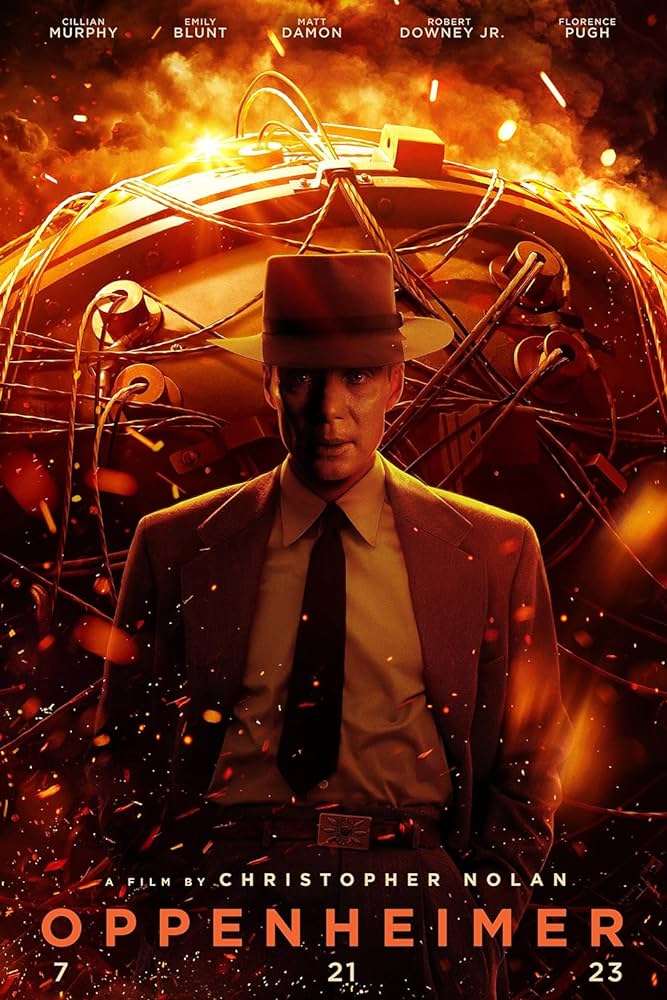
Oppenheimer, directed and written by Christopher Nolan, stars Cillian Murphy as the titular J. Robert Oppenheimer and tells the story of the scientist’s rise from brilliant physics student to leader of the Manhattan Project and his eventual fall from power in the government bureaucracy. Other notable actors and actresses in the cast include Robert Downey Jr., Matt Damon, Emily Blunt, Florence Pugh, Rami Malek, Kenneth Branaugh, and Jack Quaid. The film clocks in at around 3 hours but there is more than enough material about Oppenheimer to warrant that kind of length.
Nearly every aspect of Oppenheimer is meticulously crafted to perfection. This includes everything from the performances of the actors and actresses, the music, the costumes and sets, and the sparingly used special effects. The actors and actresses are all doing their very best with what the script gives them (which is in some cases very little). Cillian Murphy as Oppenheimer is an inspired casting choice and he does an excellent job conveying the character as a somewhat eccentric and introspective genius haunted by his own creation. Robert Downey Jr. also gives a good performance playing the smooth calculating bureaucrat Levi Strauss. In my opinion, Emily Blunt’s acting was nothing special but I would pin this on the script giving her very little to work with in terms of fleshing out her character. The films score composed by Ludwig Goransson is beautifully and perfectly encapsulates the marvel and wonder that should be associated with such a monumental feat of science and technology. The duality of the bright strings combined with the harsh horns seems to represent the duality of amazement and fear that proceeds from the realization of nuclear weapons. As to the visual effects, they are subdued but appropriate. There are people who will probably complain that the movie is too full of talking with comparatively few “mind-blowing” scenes. Additionally, the visual effects that are in the film, are mostly abstract and obscured. I found these choices to be refreshing, and the minimalism present in much of the special effect showed how you can do more with less. Simple things such as sparks and moving lights can be extremely effective when filmed and used correctly.
As far as the technical elements of filmmaking go, there is almost nothing to critique in Oppenheimer. However, the film is far from perfect with most of the problems coming from how the screenplay is written and the creative decisions over the story’s structure. The dialogue in Oppenheimer is not good for several reasons. Firstly, there is too much of it. There is a lot of dialogue in this movie, much of it unnecessary in the grand scheme of things. In many instances, characters seemingly interact more for historical accuracies sake than for the actual narrative. Additionally, the use of dialogue is sometimes a crutch as the movie then does not follow the cardinal rule, “show don’t tell”. This is not as big as an issue for myself as I am used to books and processing information in a “boring” way, but for others, the large swaths of the film that consist of Oppenheimer talking to various side characters in classrooms might seem a bit tedious. Secondly, the dialogue is very unnatural and written as if to accomplish a goal and nothing else. In other words, it seems to me that when Nolan writes dialogue, he starts out with a piece of information he needs to get across, and then has his characters say as much in a succinct and clear way. However, he neglects to keep in mind that these are characters and that they don’t always act in a succinct and clear way in conversation. There are many moments in the movie where a character will make a statement only to be immediately responded to with a coherent well worded question that doesn’t really fit into the natural flow of conversation. This is perfect for scientific discussion but it means that the characters are given less development because not much is revealed through their dialogue. Another problem with the film is the bizarre choice to give Levi Strauss a huge part in the movie. In a movie entirely focused on Oppenheimer, it feels strange to give so much screen time to what is essentially a side character who only had marginal interaction with Oppenheimer. While Robert Downey Jr. did a lot to make Strauss engaging, the audience is still left wondering why we should even care about the petty ambitions of Strauss especially considering that Oppenheimer did not actively have anything to do with his failure to be confirmed. I understand the contrast Nolan was trying to show between a scientist and an ordinary man and how conflict can arise between them but Oppenheimer seemed too passive to justify delving deeper into this theme.
To conclude, Oppenheimer is a technically brilliant historical film. It does its job telling the incredible factual story of J. Robert Oppenheimer and the incredible accomplishment of the atomic bomb.