
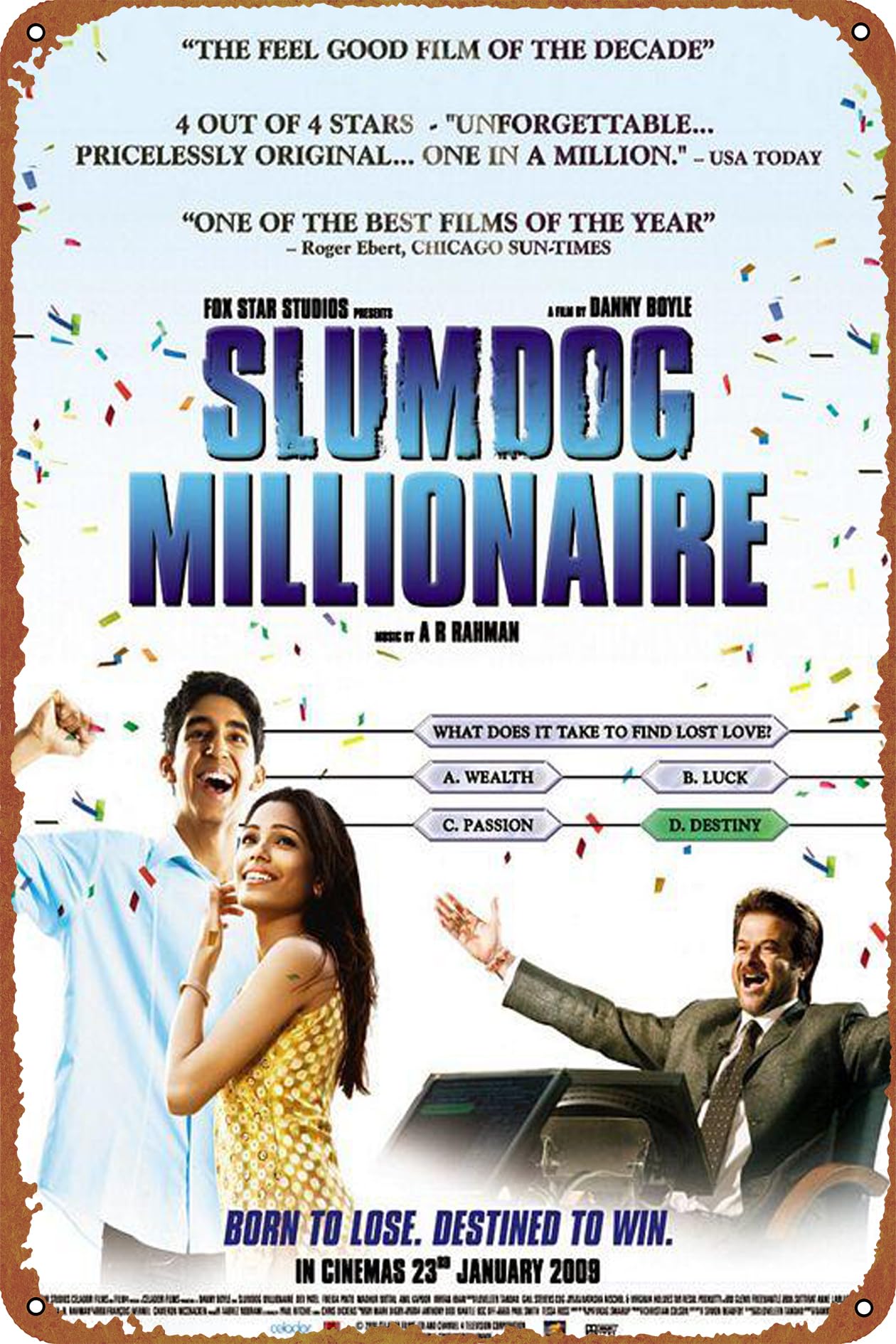
Slumdog Millionaire was directed by Danny Boyle, stars Dev Patel, Freida Pinto, and Madhur Mittal, and tells the story of a young Indian man’s rise from poverty to winning the tv show Who Wants to Be a Millionaire. While the film is technically brilliant with the music, cinematography, and editing all being top-tier, the contrived and campy plot with largely one-note characters holds the film back from being truly deserving of all-time status.
The story of the main character, Jamal Malek is shown through a series of flashbacks while Jamal’s participation in the game show acts as a framing device. This is a neat gimmick but, to me, it ultimately felt contrived and cheesy, taking away from the grittier aspects of Jamal’s real-life hardships. The film also suffers from characters with little nuance. Most of the people in the film are either entirely good or bad with conflicts between characters that do arise being resolved in cheap and easy ways without being fully explored. Jamal himself is very boring as he has no personality being only driven by his desire to rescue his childhood girlfriend. However, the movie is mostly able to mitigate this problem by keeping up a consistent pace so that we are always engaged in the latest exploits of Jamal and his brother even if we do not grow invested in their characters.
While its plot and characters leave much to be desired, on a technical level, Slumdog Millionaire is a near perfect film. The visuals in the film are done very well with the movie unafraid to create a dark and gritty atmosphere appropriate to the poverty and destitution surrounding the main characters. This was a refreshing break from the films of today which always feel so polished and clean. The color palette of the movie was also commendable and added to the surrealistic quality of the film which is fitting given it is a retelling of Jamal’s memories. The cinematography also stood out for being interesting and dynamic. Nearly every scene had a shot with a gorgeous visual or an interesting camera angle or technique. This greatly contributes to the fast-paced action scenes in the movie while also making it feel rougher and more realistic and less like a movie created on a soundstage.
A review would be remiss if it did not at least mention the criticism from many Indian film reviewers over the film’s negative portrayal of India as a nation of poverty, slums, and gangs. While it is true that the film does not make India look good as a country, it is only displaying one aspect of the region. As a counterargument, there are countless films that make America look terrible that get released and have had success. Rather than criticizing the film on this account, it would be better to invest time in telling visual stories of India that show a different aspect of the nation, one that shows the strengths and potential of the Indian people.
To conclude, one question comes to mind: How on earth did Slumdog Millionaire manage to win eight Academy Awards including Best Picture and Best Adapted Screenplay? Clearly, the film has it strengths but eight Academy Awards puts it in the realm of films like On the Waterfront and Lawrence of Arabia, a place where I think it certainly does not belong. In my opinion, Slumdog Millionaire is the kind of movie you can sit down and watch any night of the week without getting too invested. It is the kind of film that presents no strong emotional themes and, being so inoffensive, will be universally entertaining for everyone.